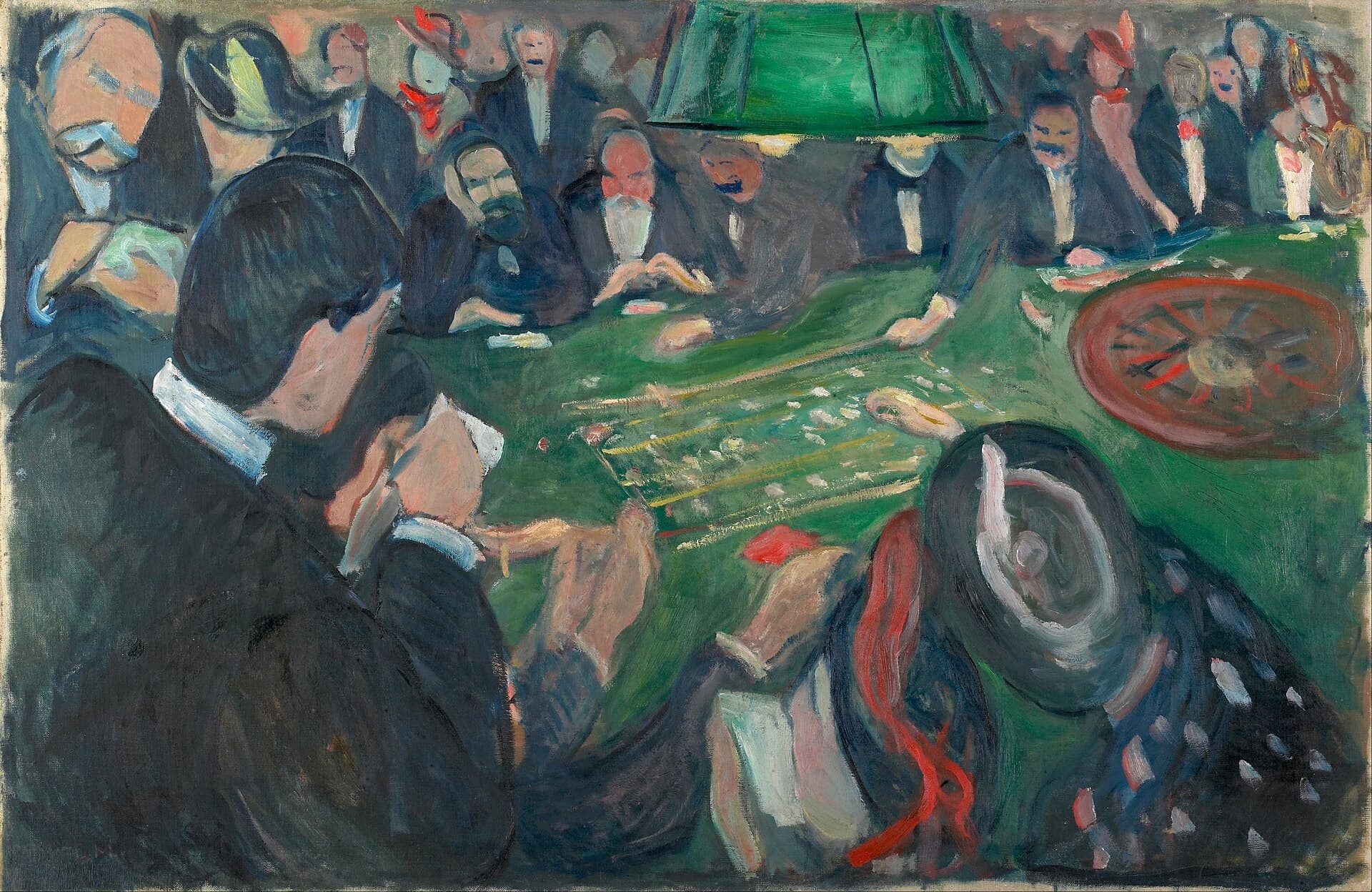
D'Alembert Strategy Explained
How the D'Alembert betting system's one-unit progression works, how it compares to Martingale, and why it's still no match for the house edge.
Published August 10, 2026
How D'Alembert works
D'Alembert is a negative progression system named after the 18th-century mathematician Jean le Rond d'Alembert, and it's built around a considerably gentler adjustment than Martingale's doubling: increase your bet by exactly one unit after a loss, and decrease it by exactly one unit after a win. There's no multiplication involved at any step — every adjustment is a simple, fixed addition or subtraction, which produces a much slower-moving bet size than Martingale's exponential growth, in either direction.
The system rests on an underlying idea sometimes called the "equilibrium" theory of gambling — the belief that wins and losses will eventually balance out over a session, so gradually betting more after losses and less after wins should, in theory, land you roughly back to even with a modest profit if that balance holds. This idea doesn't hold up mathematically (each bet remains an independent event regardless of what's balanced out so far), but the gentler mechanics it produces are genuinely different from Martingale's in practice, which is covered below. For how it applies to a specific game, see D'Alembert roulette strategy.
Example betting sequence
Starting from a $10 base bet and $10 unit size, on an even-money wager:
| Bet # | Bet Size | Outcome | Running Total |
|---|---|---|---|
| 1 | $10 | Loss | −$10 |
| 2 | $20 | Loss | −$30 |
| 3 | $30 | Win | 0 |
| 4 | $20 | Win | +$20 |
| 5 | $10 | Win | +$30 |
Each loss adds exactly $10 to the next bet; each win subtracts exactly $10. Notice how much more gradual this is than Martingale's doubling covered in the same losing-streak scenario — two consecutive losses take D'Alembert's bet from $10 to $30, compared to Martingale's identical two losses taking a $10 bet to $40. This gentler climb is D'Alembert's defining characteristic relative to more aggressive systems.
Advantages
D'Alembert's linear, one-unit-at-a-time adjustments make it considerably easier to track mentally than systems requiring multiplication or a written sequence, and its slower escalation means it takes a longer losing streak to reach any given bet size or bankroll ceiling compared to Martingale. For players who want a system that visibly responds to wins and losses without Martingale's aggressive doubling, D'Alembert offers a meaningfully gentler middle ground, and its symmetric structure (equal-sized increases and decreases) gives it a psychologically comfortable, "balanced" feel that some players find easier to stick with over an extended session.
Disadvantages
The gentler escalation comes at the cost of gentler recovery — because D'Alembert only reduces bet size by one unit per win, recovering a multi-loss losing streak takes considerably more wins than Martingale's single-win recovery, and a D'Alembert sequence can spend a long stretch of a session hovering below its starting bankroll even through a roughly even mix of wins and losses, simply because losses and wins don't need to occur in matched pairs to offset each other under this system's math. The underlying "equilibrium" reasoning behind D'Alembert is also a version of the gambler's fallacy — the assumption that results will "balance out" over a session has no basis in how independent events actually behave, covered fully in why casino strategies don't beat the house.
Bankroll requirements
D'Alembert's linear growth makes it considerably less demanding on a bankroll than Martingale for an equivalent losing-streak length — ten consecutive losses from a $10 base and unit adds $100 to the eleventh bet ($110 total) under D'Alembert, compared to Martingale's identical ten losses producing a required eleventh bet of $10,240. This is D'Alembert's most significant practical advantage: a genuinely long losing streak, while still costly, doesn't produce the same kind of runaway bet size that makes Martingale so demanding on bankroll and so exposed to table limits.
The table-limit problem
Because D'Alembert escalates linearly rather than exponentially, it takes a considerably longer losing streak to reach a typical table maximum than it does under Martingale — a real, practical advantage. That said, the system isn't immune to the issue entirely; an unusually long losing streak can still, eventually, produce a bet size beyond a given table's limit, just after many more losses than would be required to hit the same ceiling under a doubling system.
Why D'Alembert doesn't remove the house edge
Despite its gentler mechanics and its equilibrium-based rationale, D'Alembert changes nothing about the true-odds-versus-payout-odds structure of the underlying bet, which is what actually determines house edge. Every individual bet within a D'Alembert sequence carries exactly the same house edge as it would as a standalone flat bet, and averaged across every possible sequence of outcomes, D'Alembert's expected value comes out identical to flat betting the same total amount wagered — the "equilibrium" the system is built around doesn't exist as a real statistical force, since each bet remains independent of every other regardless of how the running total has moved. The complete mathematical explanation is in the casino betting strategies guide.
Frequently asked questions
How does the D'Alembert betting system work? Increase your bet by one unit after a loss and decrease it by one unit after a win, producing a gradual, linear adjustment rather than the exponential growth of systems like Martingale.
Is D'Alembert safer than Martingale? Its bankroll and table-limit exposure grow much more slowly for an equivalent losing streak, since adjustments are linear rather than exponential — a genuine practical advantage, though it still doesn't change the underlying house edge.
What is the "equilibrium theory" D'Alembert is based on? The belief that wins and losses will eventually balance out over a session, so betting more after losses and less after wins should land close to even. This has no basis in probability, since each bet is an independent event unaffected by past results.
Does D'Alembert recover losses as effectively as Martingale? No — because bet size only decreases by one unit per win, recovering a multi-loss streak takes considerably more wins under D'Alembert than the single win that fully recovers a Martingale sequence.
Does D'Alembert change my odds of winning? No — like every betting system, it adjusts bet size without changing the probability or payout structure of any individual bet, which is what actually determines house edge.