Sic Bo Probability Explained
The underlying math of Sic Bo's three dice — why 216 outcomes exist, why totals cluster around the middle of the range, and why the dice have no memory between rolls.
Published August 21, 2026
Every probability figure used throughout this guide cluster — every bet's win chance in Sic Bo Odds Explained, every house edge in Sic Bo House Edge Explained — traces back to the same underlying math: three independent six-sided dice, and the 216 possible ways they can land. This guide is about that underlying math itself, not its application to any specific bet. If you want the practical, bet-by-bet numbers, those two guides linked above are the right place; this one is for understanding where those numbers actually come from.
Why Three Dice Produce 216 Outcomes
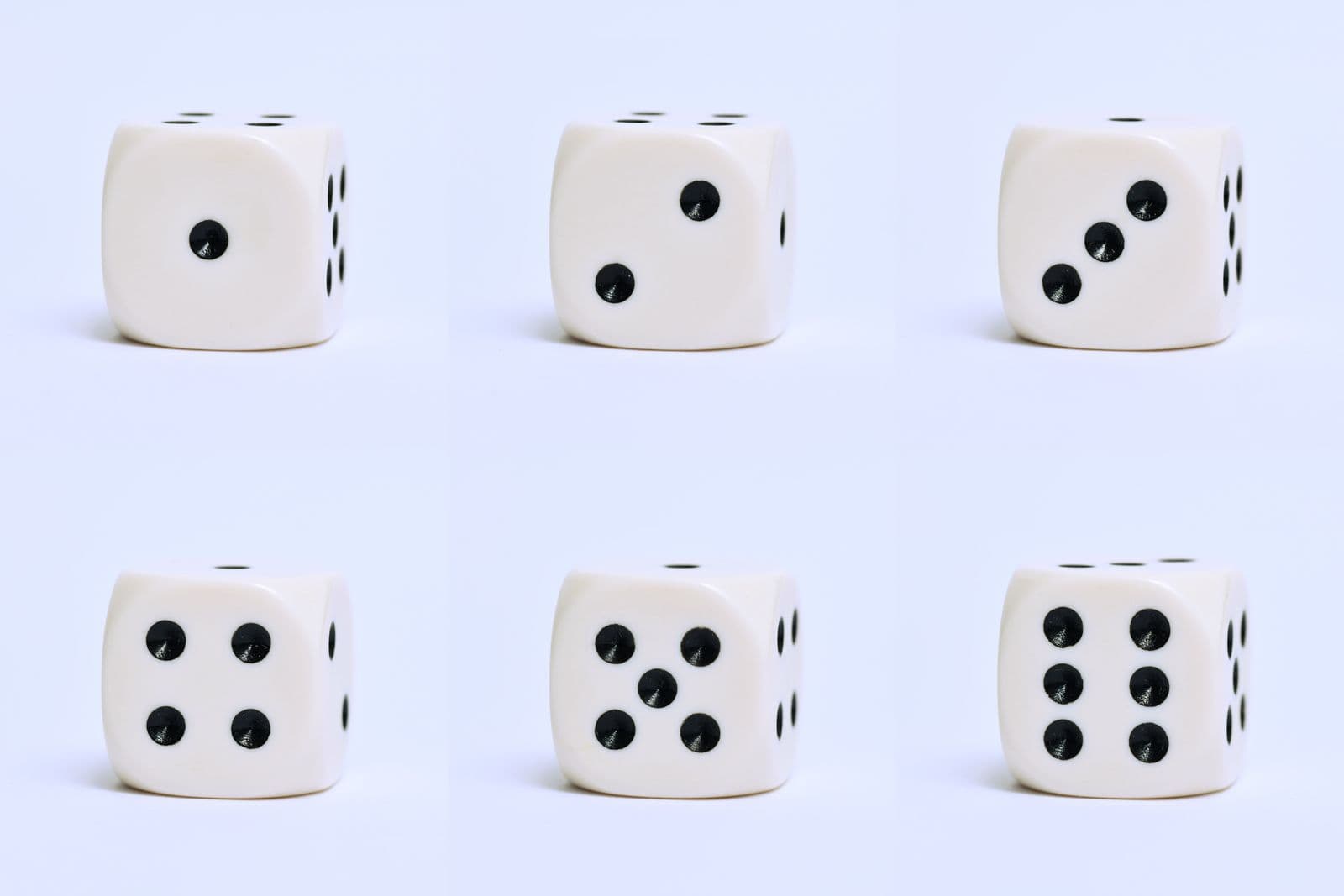
Each of the three dice has six faces, and each die's result is entirely independent of the other two — nothing about how one die lands affects either of the others. When outcomes are independent, the total number of possible combinations multiplies rather than adds: 6 × 6 × 6 = 216. This counts ordered outcomes, meaning a roll of (1, 2, 3) on dice one, two, and three is counted separately from (3, 2, 1) or (2, 1, 3), even though all three contain the same three numbers — because in principle each individual die is a distinguishable object, even if in practice you can't tell which physical die produced which number.
Counting Outcomes vs. Counting Combinations
This distinction between ordered outcomes and the underlying number combination is the single most important concept for understanding Sic Bo's math, and it's worth working through directly. Take the numbers 4, 4, and 5 — one specific unordered combination. How many of the 216 ordered outcomes correspond to it? Since two of the three dice show the same number, there are exactly 3 distinct orderings: (4, 4, 5), (4, 5, 4), and (5, 4, 4). Compare that to a triple, like 4, 4, 4: since all three dice are identical, there's only 1 possible ordering — you can't rearrange three identical numbers into anything different. And compare both to a combination with three distinct numbers, like 1, 2, 3: with three different values, there are 3! = 6 possible orderings.
This is exactly why triples are so much rarer than other outcomes with the same numbers involved: a triple has only 1 way to occur out of 216, while a combination of three distinct numbers has 6 ways to occur, and a combination with exactly one repeated pair has 3 ways to occur. The dice aren't "less willing" to land on a triple — there are simply far fewer ordered arrangements that produce one.
The Full Distribution of Totals
Counting how many of the 216 outcomes produce each possible total (from the minimum of 3, all 1s, to the maximum of 18, all 6s) produces this distribution:
| Total | Outcomes | Total | Outcomes |
|---|---|---|---|
| 3 | 1 | 11 | 27 |
| 4 | 3 | 12 | 25 |
| 5 | 6 | 13 | 21 |
| 6 | 10 | 14 | 15 |
| 7 | 15 | 15 | 10 |
| 8 | 21 | 16 | 6 |
| 9 | 25 | 17 | 3 |
| 10 | 27 | 18 | 1 |
Add every value in the "Outcomes" column and the total comes to exactly 216, confirming every possible roll is accounted for exactly once. The shape is symmetrical around the midpoint (10 and 11 tie for the peak) and tapers off toward both extremes in mirror image — 3 and 18 are equally rare, 4 and 17 are equally rare, and so on all the way up.
Why the Middle Totals Dominate
This bell-like shape isn't unique to Sic Bo — it's the same underlying pattern that appears any time you sum multiple independent random values, sometimes referred to loosely as a version of the central limit tendency in elementary probability. Intuitively: there's only one way to roll the minimum total (all three dice showing 1) or the maximum (all three showing 6), but there are dozens of different combinations of three dice that add up to a middle value like 10 or 11 — different dice can compensate for each other (a low value on one die paired with a higher value on another) in many different ways, while an extreme total requires every single die to cooperate simultaneously. The practical consequence, covered directly in Sic Bo Odds Explained, is that Total bets near the middle of the range win far more often — and therefore pay far less — than Total bets near the extremes.
Independence and the Gambler's Fallacy
Every roll of the three dice is a completely fresh, independent event, unconnected to any roll before it. This matters because it directly rules out a very common but mistaken instinct: believing that a number "hasn't shown up in a while" and is therefore somehow due, or that a total which just hit is now less likely to repeat. Neither is true. The dice have no memory, and the probability of any specific outcome on the next roll is identical to what it was on the very first roll of the session, regardless of what's happened since. This mistaken belief has a name — the gambler's fallacy — and it shows up constantly around dice and roulette-style games specifically because both feel like they should have some pattern to track, when in fact each event is fully independent of the last.
Variance and Why Streaks Happen Anyway
None of this independence contradicts the fact that streaks genuinely happen — a specific total hitting three times in five rounds, or a triple appearing twice in a short session, is a real and expected feature of randomness, not evidence that something unusual is going on. This is what statisticians call variance: even a perfectly fair, independent random process produces short-term clusters and streaks purely by chance, and a small sample of rolls (a single session) is exactly where those clusters are most visible. Over a very large number of rolls, the actual frequency of every outcome converges toward its true theoretical probability from the tables above — but "a very large number" typically means many thousands of rolls, far beyond what a normal session involves, which is why short-run results can look meaningfully different from the long-run math without anything being wrong.
A Concrete Illustration of Variance
Imagine tracking 20 rounds of Sic Bo and counting how often a total of 10 or 11 appears. The theoretical probability for that combined outcome is 54/216, or exactly 25% — so over 20 rounds, the mathematically "expected" count is 5. In practice, a real run of 20 rounds might show it 2 times, or 9 times, and neither result would be surprising or would indicate anything is biased about the dice; with a sample this small, deviations of that size are entirely ordinary. Only across a much larger sample — hundreds or thousands of rounds — does the observed frequency reliably converge close to that 25% figure. This is worth sitting with directly, since it's the mathematical reason a short session can feel wildly "hot" or "cold" relative to the theoretical odds without any of the underlying math being wrong.
Common Misconceptions Worth Correcting
A few beliefs about Sic Bo's dice come up often enough to address directly:
- "A number that hasn't appeared in a while is due." False — see the gambler's fallacy above. Each roll is independent.
- "A shaker that's been used for many rounds gets more predictable." False for any properly maintained, regulated table — physical wear that would meaningfully bias a die is exactly what regular dice inspection and rotation exists to prevent, as covered in How to Play Sic Bo.
- "Betting on the total that hit last round is a bad idea because it 'already happened.'" Also false, for the identical reason — the previous roll has zero bearing on the next one, in either direction.
- "Patterns across several rounds can be tracked to predict the next roll." No pattern-tracking approach can produce an edge on a genuinely random, independent process — any perceived pattern in a short sequence of rolls is coincidence, not signal.
Frequently Asked Questions
Why are there 216 possible outcomes instead of some other number? Because three independent six-sided dice combine as 6 × 6 × 6, since each die's result is unaffected by the other two and each has six possible faces.
Why is a triple so much rarer than other three-number combinations? Because there's only one possible ordering of three identical numbers, while a combination with two or three distinct numbers has multiple possible orderings (3 for a pair-plus-single, 6 for three distinct numbers) — more orderings means more of the 216 total outcomes satisfy it.
Does the "central limit" pattern mean totals eventually become perfectly predictable? No — it describes the shape of the probability distribution across many possible outcomes, not a guarantee about any specific roll. Every individual roll remains entirely random and independent, regardless of how smooth the underlying distribution looks in aggregate.
If a specific total hasn't appeared in a long time during a session, does that mean it's more likely soon? No. This is precisely the gambler's fallacy — the dice carry no memory of previous rolls, so a total's probability on the next roll is unaffected by how long it's been since it last occurred.
Is there any legitimate way to use past rolls to predict future ones in Sic Bo? No — with a fair, properly maintained set of dice, every roll is fully independent, and no history of past results carries any predictive information about the next one.
Why does this guide matter if I just want to know my odds on a specific bet? It doesn't need to, strictly — Sic Bo Odds Explained gives you the practical numbers directly. This guide exists for understanding where those numbers come from, for anyone who wants that deeper layer.